
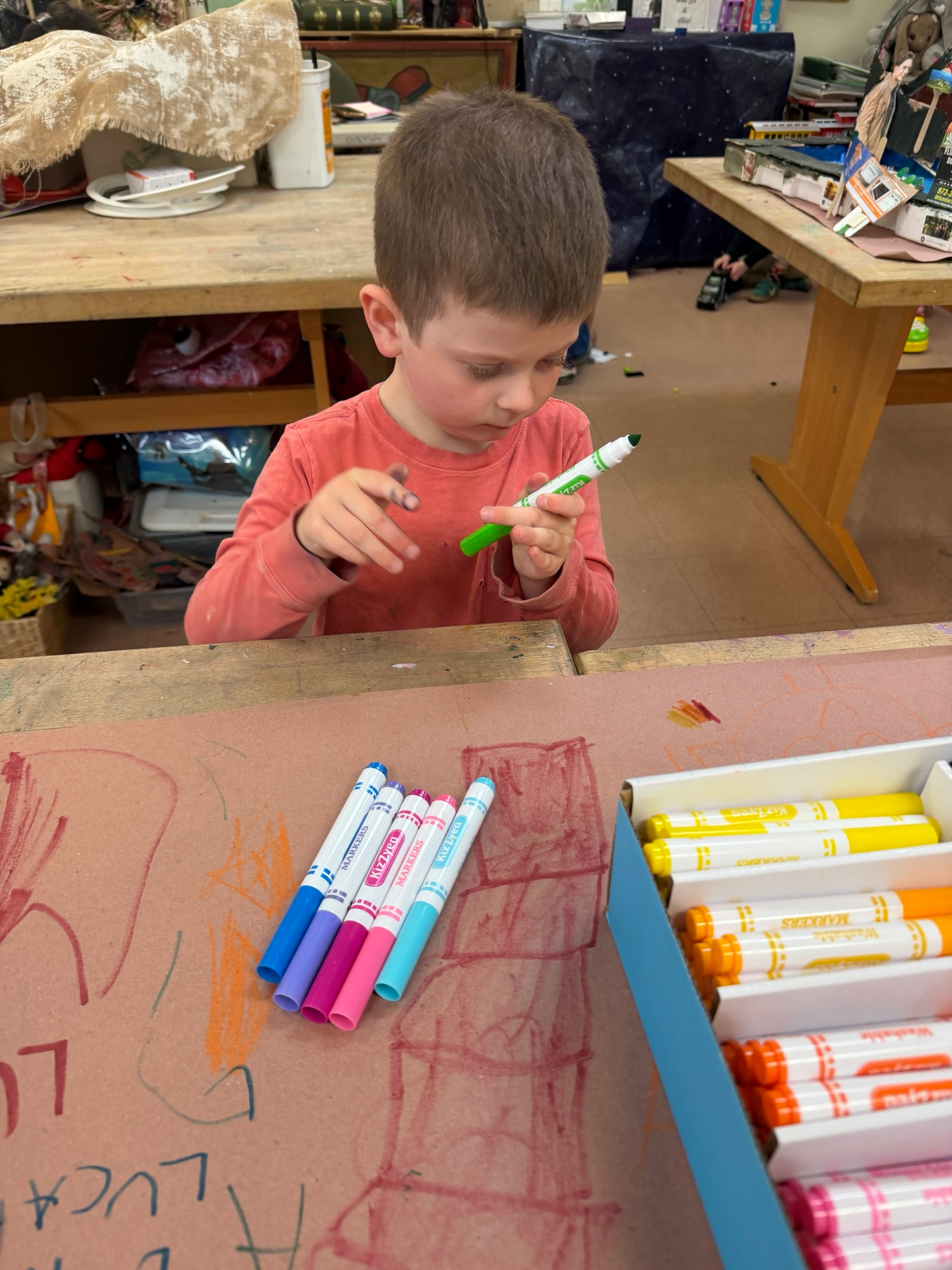
For more than forty years, I have worked with children as an artist, art educator, and parent. During that time, I have taught thousands of art classes, watched children grow from preschoolers into adults, and listened to countless conversations about confidence, learning, success, and failure.
Confidence rarely develops the way we think it does.
Confidence does not come from constant praise.
It does not come from being the most talented child in the room.
It does not come from avoiding mistakes.
In fact, some of the most confident adults I know were not the children who found everything easy.
They were the children who learned how to stay engaged when things became difficult.
Do Let Children Struggle
One of the most common moments in an art class happens when a child says:
“I can’t do it.”
Usually, what they mean is:
“I can’t do it yet.”
The temptation for adults is to step in immediately. We want to fix the drawing, show the answer, erase the mistake, or demonstrate the technique.
But every time we solve the child’s problem, we remove an opportunity for growth.
Some of the strongest confidence I have ever witnessed appeared after a child struggled through a difficult drawing and finally discovered:
“I did it myself.”
We cannot give that moment; it has to be experienced.
Art-making insight I
When your child encounters difficulty in a project, resist the urge to take over.
Instead ask:
“What is one thing you could try next?”
Allow experimentation before offering solutions.
Don’t Remove Every Obstacle
In art, there is no perfect path.
Paint spills.
Clay collapses.
Colors become muddy.
Ideas fail.
Children who are protected from every difficulty often become anxious when things don’t go as planned.
Children who regularly experiment become comfortable with uncertainty.
Art teaches a powerful lesson:
Mistakes are not emergencies.
They are information.
Art-making insight II
Create a “beautiful mistakes” folder for children to collect drawings, experiments, and projects that did not go as planned. Revisit them later and discuss what was learned.
Art-making insight III
Praise Persistence More Than Talent
Over the years, I have taught exceptionally talented children who quit when things became difficult.
I have also taught children with modest technical skills who became extraordinary artists because they kept showing up.
Talent may open a door.
Persistence determines how far someone travels.
When we praise effort, curiosity, observation, and perseverance, children begin valuing qualities they can develop.
Instead of commenting on the final artwork first, ask:
“What part took the most patience?”
“What changed from your first idea?”
“What did you discover while making it?”
Art-making insight IV
Don’t Build Identity Around Being Gifted
Children who are constantly told they are talented often become afraid of situations where they are beginners.
In art classes, I sometimes see children avoid new techniques because they worry their work won’t look good.
Confidence is not believing you will succeed every time.
Confidence is being willing to begin.
Art-making insight V
Introduce activities where neither you, as a parent, nor the child knows the outcome.
Experiment with unfamiliar materials.
Draw with your non-dominant hand.
Create from imagination without a reference image.
Practice being beginners together.
If I could choose one lesson that art teaches better than almost anything else, it would be this:
The first version is rarely the final version.
Artists revise.
Writers revise.
Inventors revise.
Life itself is a process of revision.
Children who understand this become more resilient because they stop expecting perfection.
Art-making insight VI
Ask children to create three versions of the same drawing or idea.
Afterward, discuss how each version improved and what changed.
It teaches that growth happens through repetition rather than instant success.
Art-making insight VII
Don’t Turn Every Mistake Into a Lecture
Sometimes a child already knows.
A drawing did not work.
A sculpture broke.
A project was rushed.
Growth often happens during reflection, not correction.
Instead of explaining what went wrong, ask:
“What would you do differently next time?”
Then listen.
Children often discover their own solutions.
Art-making insight VIII
Listen More Than You Teach
Art classes provide a unique opportunity to observe children without constant instruction.
When children create, they often reveal what excites, worries, fascinates, and inspires them.
The most valuable information comes from listening to them.
Art-making insight IX
Once a week, invite your child to explain their artwork while you listen without correcting, interpreting, or evaluating.
Be curious.
You may learn far more than you expected.
Art-making insight X
Don’t Solve Every Emotional Problem
Every artist experiences frustration.
Every creator experiences doubt.
Every meaningful project includes moments of uncertainty.
Children need opportunities to discover that difficult emotions are survivable.
Confidence grows when children realize:
“I can feel frustrated and continue.”
“I can feel disappointed and continue.”
“I can feel uncertain and continue.”
Art-making insight XI
Keep unfinished work visible.
Allow children to return to challenging projects over several days.
It teaches that temporary frustration does not mean something is impossible.
Art-making insight XII
Encourage Creativity
Creativity is often misunderstood as artistic talent.
In reality, creativity is the ability to generate possibilities.
It is flexible thinking.
It is curiosity.
It is problem-solving.
Children who develop creativity are better equipped to adapt to change throughout their lives.
Art-making insight XIII
Offer open-ended materials such as cardboard, fabric, recycled objects, paint, clay, and paper.
Avoid projects where every child is expected to produce the same result.
The goal is exploration, not replication.
Art-making insight XIV
Don’t Overcorrect
One of the quickest ways to weaken confidence is to communicate that every effort requires improvement.
Children need places where they can create freely.
Not every drawing requires instruction.
Not every project requires evaluation.
They need space to play.
Art-making insight XV
Set aside occasional “no correction” art sessions where there are no examples, no grading, and no suggestions.
Only making.
Only exploring.
Only discovering.
Art-making insight XVI
Teach Responsibility Through Contribution
Children develop confidence when they see that their actions matter.
In an art studio, students clean brushes, organize materials, help younger children, prepare displays, and contribute to the community.
These small responsibilities communicate an important message:
You are capable.
You belong here.
You matter.
Art-making insight XVII
Invite children to help organize family art supplies, curate artwork for display, or prepare materials for a creative activity.
Contribution builds ownership.
Ownership builds confidence.
Final Thoughts
After four decades of teaching, I have become less interested in raising successful children and more interested in raising capable adults.
Art shows us that growth is rarely linear.
The line wobbles.
The paint drips.
The sculpture falls apart.
The idea changes.
And then, somehow, something beautiful emerges.
Children are much the same.
Our role is not to create the finished masterpiece.
Our role is to provide the space, the materials, the encouragement, and the trust that allow them to become themselves.
Confidence grows in that space because we made room for it to emerge.